
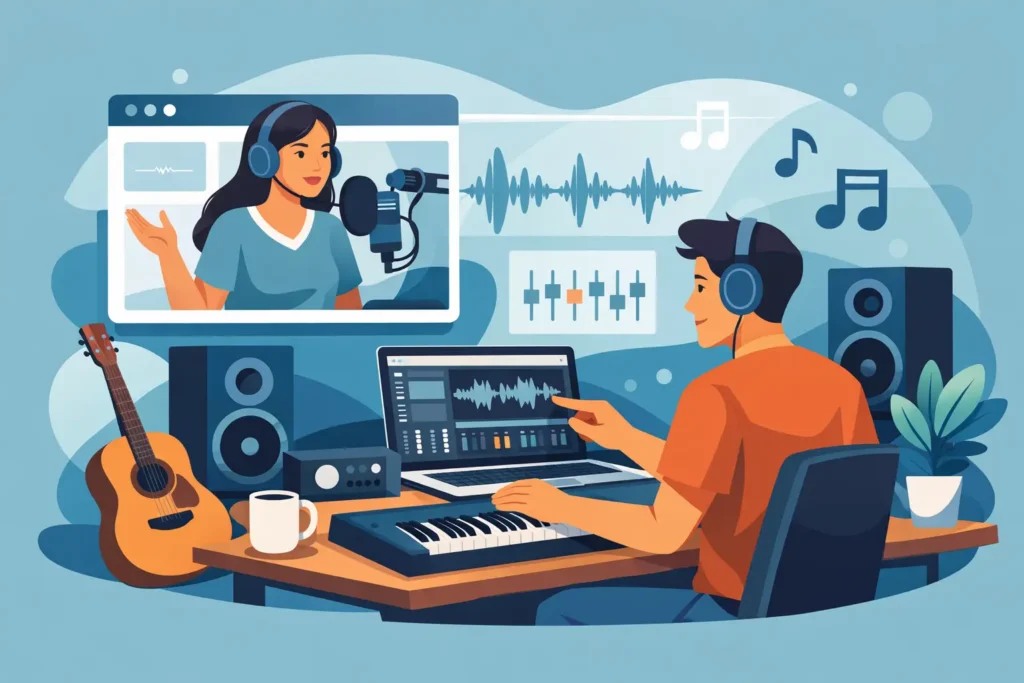
If you have ever spent three hours watching tutorials just to fix one routing problem, choose the wrong buffer setting, or figure out why your MIDI keyboard stopped talking to your DAW, you already know what the best online music production coaching looks like. It is not more videos. It is not theory with no application. It is real-time help from someone who can look at your exact setup, hear the problem, and show you what to do next.
That point matters because music production is rarely one problem at a time. A session can fall apart because of gain staging, interface settings, plugin latency, bad room decisions, weak arrangement choices, or a simple menu setting buried three layers deep. Generic education treats those problems separately. Good coaching treats them as part of one workflow.
What the best online music production coaching actually does
Most producers do not need more information. They need better implementation. That is the difference between passive content and coaching that gets results.
The best online music production coaching gives you direct feedback on your songs, your DAW, your hardware, and your habits. If you are working in Studio One, Pro Tools, Cubase, Logic Pro, or Ableton Live, the coach should be able to help inside the software, not just talk around it. If your issue involves an interface, a control surface, MIDI routing, vocal chain setup, or export settings, the coaching should cover that too.
A lot of training sounds good on paper and falls apart in practice. A polished course may explain compression well, but it cannot tell you why your vocal still sounds buried in your mix. A forum thread may mention five possible fixes, but it cannot hear your session and narrow the problem down in minutes. Real coaching closes that gap.
Why live coaching beats prerecorded lessons
Prerecorded lessons are useful when you need a broad introduction or want to learn at your own pace. They are efficient for fundamentals. The trade-off is that they cannot adjust to your exact problems.
That trade-off gets expensive fast. If you are new to production, you may not even know what question to ask. If you are intermediate, you probably know enough to get stuck in more frustrating ways. Advanced users have the opposite problem. They can move quickly, but when something breaks, they lose serious time.
Live coaching works because it cuts through all three situations. A real instructor can tell whether your issue is technical, creative, or workflow-based. That sounds simple, but it is the reason progress speeds up. You stop guessing. You stop patching together advice from ten sources. You start solving the right problem first.
For home studio users, this matters even more. Every room, computer, interface, plugin collection, and production style is different. A lesson that worked for someone on a Mac running Logic with a small USB interface may be useless for someone on a Windows system using Pro Tools and external hardware. The best coaching accounts for those differences instead of pretending they do not exist.
How to judge coaching quality before you pay
The first thing to look for is whether the training is one-on-one and live. If it is mostly a library of videos with occasional support, that is not really coaching. It is a course with customer service attached.
The second thing is software and hardware range. A serious coaching service should be fluent in major DAWs and common studio gear. Not because every producer uses the same tools, but because your setup rarely stays static. You may start in Ableton Live and later need help moving stems into Pro Tools. You may add a new interface, outboard processor, or MIDI controller and suddenly your stable workflow is not stable anymore.
The third thing is whether the coach can work from your goals rather than from a canned curriculum. Some clients need mixing help. Some need setup and troubleshooting. Some need arrangement feedback, vocal production guidance, mastering prep, or release workflow coaching. The best services meet you where the bottleneck is.
Responsiveness matters too. If your session is crashing, your artist is showing up in two hours, and your interface is not recognized, speed matters more than elegant theory. Good coaching should help you get unstuck quickly, then explain what happened so you do not repeat the problem.
Signs you need coaching instead of more self-study
If you finish tracks slowly, keep restarting mixes, or feel like every session begins with troubleshooting, you are not dealing with a motivation issue. You have a workflow issue.
If your music sounds inconsistent from song to song, coaching can help identify whether the problem is monitoring, gain structure, arrangement density, editing, or decision-making. Producers often blame plugins when the real issue is a repeatable habit upstream.
If you own good gear but still cannot get professional results, that is another strong sign. Better equipment does not fix a broken process. In many cases, it adds more variables. The right coach simplifies the system so your tools work together instead of against you.
And if you are a beginner, getting help early can save months. Bad habits in session setup, file management, recording levels, and plugin use are much easier to prevent than to undo.
What a strong coaching session should feel like
A good session should feel specific. Not inspirational. Not vague. Specific.
You should leave with clearer settings, better decisions, and a more reliable process. Maybe that means fixing latency while tracking vocals. Maybe it means organizing your template so writing does not turn into tech support. Maybe it means hearing exactly why your low end collapses when the chorus hits.
You should also feel that the coach can move between technical and musical issues without getting lost. Music production is not only engineering. It is arrangement, tone, timing, editing, balance, and translation. A coach who can only explain menus is limited. A coach who only talks creativity without fixing your session is also limited.
This is where experience matters. The best coaching is practical because it comes from people who have seen the same kinds of problems across many systems, genres, and skill levels. They know which issue is urgent, which can wait, and which symptom points to a deeper problem.
Best online music production coaching for different levels
Beginners need clarity and a stable foundation. That means learning signal flow, recording basics, DAW navigation, MIDI, editing, and simple mixing decisions without being overloaded. A good coach keeps the learning curve manageable and prevents the usual beginner trap of buying tools before learning process.
Intermediate producers usually need refinement. They can record, edit, and build sessions, but they hit walls in consistency. Their mixes do not translate. Their sessions get messy. Their creative momentum stalls because technical friction keeps interrupting it. Coaching at this level should tighten workflow and sharpen decision-making.
Advanced users need precision. They may want help integrating hardware, improving mastering prep, handling complex routing, dialing in vocal production, or solving edge-case DAW behavior. At this level, the wrong answer wastes real time and real money. Generic advice is especially costly here.
That range is why one-size-fits-all education struggles. The best online music production coaching adapts to the person in front of it.
What separates a real coaching service from a content business
A content business teaches in public. A coaching service solves problems in private.
That distinction matters because your toughest production issues are usually not general. They are personal to your room, your machine, your habits, and your goals. That is why so many musicians hit a ceiling with free content. The information is not always bad. It is just not aimed at the exact obstacle in front of them.
A company like OBEDIA stands out because it is built around live, one-on-one help from real audio engineers, not around hoping a video library happens to match your setup. That approach is more useful for producers who value speed, accuracy, and direct answers over passive consumption.
There is still a place for tutorials. They are fine for broad learning and quick references. But when your studio is not working, when your tracks are not improving, or when your workflow keeps dragging your creativity down, coaching is the faster path.
The right coach does more than teach features. They help you build a production process you can trust. And once that happens, your sessions start moving the way they should – less confusion, fewer dead ends, more finished music.
If you are serious about getting better, look for coaching that can meet you live, inside your actual setup, and push your work forward today, not someday.