
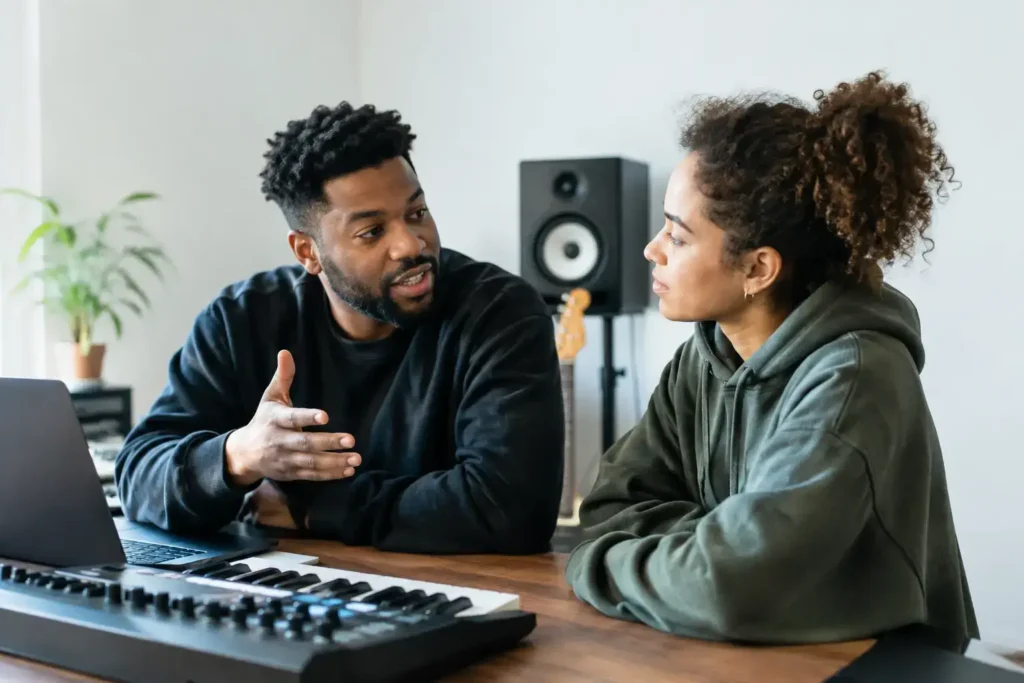
A mentorship is not successful because you had a great conversation about compressors or watched someone build a beat. Music producer mentorship outcomes should show up in your sessions: fewer technical dead ends, clearer creative decisions, and more songs that actually get finished.
That standard matters because most producers do not need more information. They need help applying the right information to their own DAW, interface, plugins, room, and musical goals. A generic video may explain sidechain compression perfectly and still leave you wondering why your vocal chain is clipping, your MIDI controller is not responding, or your mix falls apart in the car.
The right mentor closes that gap. They do not simply tell you what to try. They help you see why your current workflow is slowing you down, then work with you until the solution makes sense in practice.
What Strong Music Producer Mentorship Outcomes Look Like
The most valuable result is not a folder full of notes. It is independent progress. After a good one-on-one session, you should be able to repeat the process on the next song without hunting through menus or starting another search.
That does not mean every producer needs the same milestones. A first-time Logic Pro user may need a reliable template, properly configured monitoring, and the confidence to record a clean vocal. An experienced Ableton Live producer may need to improve arrangement decisions, get control of low-end translation, or build a faster system for finishing client work.
Good mentorship meets the actual bottleneck. It also makes the result measurable.
You finish more music
Unfinished projects are rarely caused by a lack of ideas. More often, the project stalls when a creative decision turns into a technical problem. Maybe the session is overloaded, the routing became confusing, the vocal comp feels messy, or you cannot get a mix loud enough without making it harsh.
A mentor helps you move from problem to decision. That may mean simplifying a production, setting up buses correctly, committing to sounds earlier, or using reference tracks with a clear purpose. The outcome is not just “better knowledge.” It is a track that reaches the arrangement, mix, revision, and release stages.
Finishing more music also teaches lessons that starting loops cannot. You hear where your songwriting holds up, where the arrangement loses energy, and where your mix decisions need work. Those are the skills that compound.
Your DAW becomes a working environment, not an obstacle
Pro Tools, Studio One, Cubase, Logic Pro, and Ableton Live are deep platforms. That is useful, but it can be costly when you are trying to work under creative pressure. Every unnecessary click interrupts momentum.
Effective mentorship improves the way you navigate, record, edit, route, automate, and organize sessions. You may build templates for your usual recording setup, learn shortcuts that match your habits, create track presets, or solve recurring problems with buffer settings and latency.
The goal is not to memorize every feature in the manual. It is to make the features you use most reliable and fast. If you record yourself, produce artists, make beats, or mix your own releases, your workflow should support that job instead of forcing you to adapt to somebody else’s tutorial project.
You make decisions with a reason behind them
Beginners are often told to use certain EQ frequencies, compressor ratios, or mastering chains as if production were a recipe. That approach can get a sound moving, but it breaks down when the source, genre, arrangement, or playback system changes.
A capable mentor teaches decision-making in context. Why is the kick fighting the bass? Is the vocal actually too dark, or is the instrumental too bright? Does the chorus need another layer, or does it need fewer competing parts? Should you use saturation, change the sound selection, or revise the arrangement first?
Those questions matter because production is a chain of trade-offs. More compression can create consistency but remove impact. Wider effects can add scale but weaken mono compatibility. A louder master may impress at first and still sound fatiguing after a minute. Strong guidance helps you hear the trade-off and choose intentionally.
Technical problems stop stealing studio time
There is a difference between learning production and spending three hours trying to make your interface appear in a DAW. Both may be necessary, but only one gets your song closer to completion.
A practical mentor can help isolate problems involving audio interfaces, drivers, sample rates, MIDI devices, plugin scans, routing, monitoring, and remote collaboration. More importantly, they can explain the underlying signal flow so the next issue is easier to diagnose.
This is where personalized help has a clear advantage over broad advice. The answer depends on the computer, operating system, DAW version, device driver, and exact connection in front of you. A solution that works for one creator can be completely wrong for another.
The Difference Between Advice and Real Progress
Not all mentorship produces the same result. Some relationships offer encouragement, career perspective, and creative feedback. Those are useful, especially if you need accountability or a more experienced set of ears.
But if your main problem is execution, you need mentorship that includes implementation. You should be able to bring in a real session, share the screen, identify what is happening, and fix it while an experienced engineer is there to answer the next question.
That is different from a course. Courses are efficient for structured foundations and can be valuable when you need a broad overview. They are less effective when your problem is specific: a failed vocal routing setup, an unreliable MIDI keyboard, an arrangement that is not landing, or a mix that does not translate outside your room.
It is also different from collecting opinions online. Feedback can be helpful, but ten conflicting comments rarely create a repeatable workflow. Direct guidance gives you a process, not another pile of options.
How to Measure Your Results After a Few Sessions
Do not judge mentorship only by whether the mentor sounds knowledgeable. Judge it by what changes in your work over the next several weeks.
You should notice that you recover from problems faster. You know where to look when sound is missing or latency appears. You can start a new project without rebuilding the same setup from scratch. You are more willing to commit to arrangement and mix decisions because you understand what you are hearing.
Your project folders should also tell the story. Are there more completed demos, stronger mixes, and organized sessions you could reopen tomorrow? Have you developed templates, routing systems, and production habits that save time? Can you explain your own process well enough to repeat it?
For artists and professionals, results may extend beyond the DAW. You might leave with better file-delivery practices, clearer revision systems, a practical release plan, or a more realistic understanding of what to prepare before sending work to a mixing or mastering engineer. These are not glamorous outcomes, but they prevent expensive delays.
What to Bring to a Mentorship Session
The fastest sessions start with a specific goal. “I want to get better at producing” is real, but it is too broad to solve in an hour. A better starting point is: “My vocals feel disconnected from the instrumental,” “I cannot record without noticeable delay,” or “I have six songs stuck at the arrangement stage.”
Bring the actual session whenever possible. Include a short description of your setup, what you already tried, and what a successful result would sound or look like. If you are unsure, a good mentor can help narrow the problem down, but clear examples save time.
Be ready to work, not just observe. Take notes if that helps, but also drive the DAW yourself. Ask why a setting is being changed. Repeat the step before the session ends. That is how a fix becomes a skill.
The Outcome That Matters Most
The best mentorship eventually makes you less dependent on mentorship. You should still have access to an expert when a complex project, new tool, or unfamiliar technical issue comes up. But day-to-day, you should be more capable, more decisive, and more productive on your own.
That is the value of live, one-on-one instruction from a team like OBEDIA: your actual questions get answered in the context of your actual studio. You are not left trying to translate a polished tutorial into a system that does not match yours.
If your sessions keep stalling at the same point, do not accept that as part of being a producer. Put a real project on the screen, solve the immediate problem, and build a workflow that lets the next idea become a finished record.