
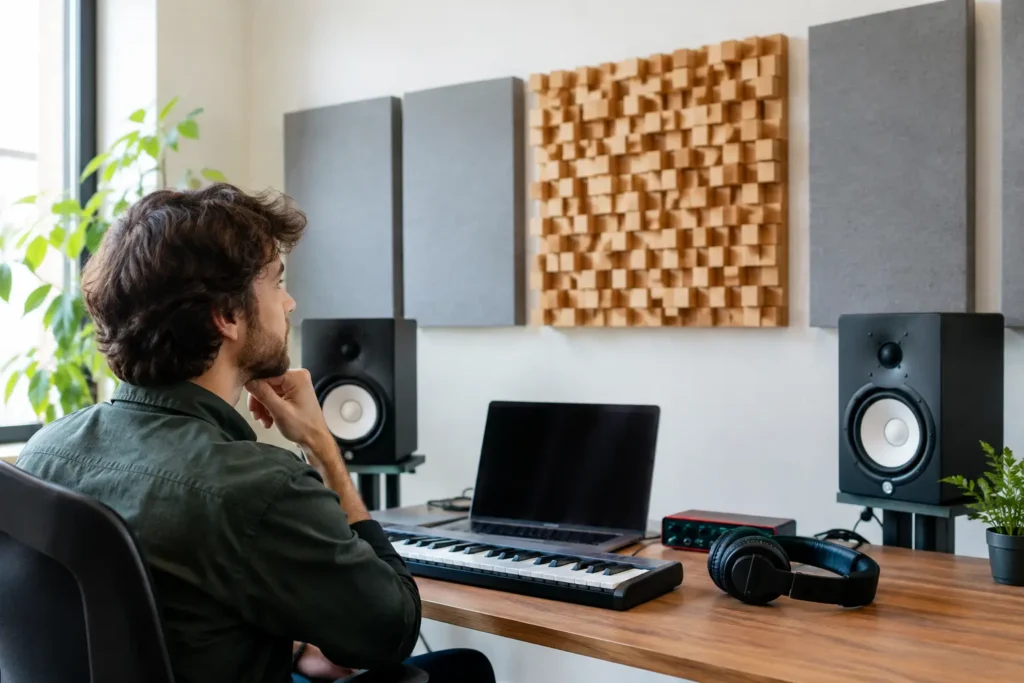
Your mix sounds balanced on headphones, then turns harsh in the car. Your vocal recording has a strange boxy ring you cannot EQ away. The kick drum disappears at your desk but booms three feet behind it. If you are asking, do I need acoustic treatment, those are the kinds of problems that should get your attention.
Acoustic treatment is not studio decoration, and it is not a shortcut for weak monitoring, bad mic technique, or unfinished production skills. It is a practical way to make your room stop lying to you. For most home producers, that means clearer mix decisions, more reliable recordings, and fewer hours spent fixing problems that were created by the space itself.
Do I Need Acoustic Treatment? Start With the Job of Your Room
The answer depends on what you do in the room and how much you need to trust what you hear. If you only sketch ideas on headphones and never record vocals, you may not need a fully treated space right away. A few workflow improvements, better headphone calibration habits, and reference tracks may move the needle more than buying foam.
If you mix on speakers, record vocals, acoustic guitar, amps, or percussion, treatment becomes much more valuable. Untreated bedrooms, offices, and spare rooms create reflections that reach your ears shortly after the direct sound from your monitors. Those reflections can exaggerate or cancel frequencies, blur stereo placement, and make reverb choices harder to judge.
Low frequencies are usually the biggest issue. A room can make 80 Hz sound huge at the listening position, causing you to remove too much bass from a mix. Play that same mix elsewhere and it sounds thin. Or the room may cancel low end where you sit, pushing you to add bass that overwhelms every other playback system.
That is why the question is not really, “Do I need panels?” It is, “Can I consistently hear what my speakers and microphones are actually doing?”
Signs Your Room Is Affecting Your Work
You do not need expensive measurement gear to identify obvious trouble. Clap your hands sharply in the room. A short, metallic flutter or ringing tail between parallel walls is a warning sign. Speak or sing at normal volume and listen for an exaggerated, hollow, or hard reflection around the voice.
Your mixes offer stronger evidence. If you repeatedly fight muddy low mids, unpredictable bass, piercing upper mids, or stereo imaging that collapses outside your room, do not assume the DAW, plug-ins, or monitors are the problem. The room may be driving those decisions.
Record a dry vocal with the microphone set up in different locations. If one spot sounds noticeably more open, less splashy, and easier to compress, you have just heard how much the room matters. This is common in home studios. The interface and microphone may be perfectly capable, but the space around the performer is working against them.
What Acoustic Treatment Actually Fixes
Acoustic treatment controls sound inside the room. It reduces unwanted reflections, manages bass buildup, and improves the accuracy of your monitoring and recordings. It does not make a room soundproof.
Soundproofing is about keeping sound from getting in or out. It involves construction details such as mass, airtight seals, isolation, decoupling, doors, windows, and ventilation paths. Hanging panels on a wall will not stop a neighbor from hearing your drums, and it will not eliminate traffic noise from a vocal take.
For a typical production room, treatment usually focuses on three areas:
- Broadband absorption at early reflection points to improve stereo imaging and reduce comb filtering.
- Bass trapping in corners to reduce low-frequency buildup and long bass decay.
- A controlled recording area that keeps vocal and instrument tracks from sounding overly reflective.
The material and placement matter. Thin foam can reduce some high-frequency reflections, but it does very little for the low end that causes many mixing problems. A room covered in thin foam often sounds dull on top while still sounding uneven in the bass. That is not a balanced result.
Start With Placement Before You Buy Anything
Treating a poorly arranged room can waste money. First, position your desk and monitors as well as the room allows. In many rectangular rooms, placing your setup on the short wall so you face down the length of the room gives bass more distance to develop. Keep your listening position roughly centered between the side walls, but do not place it exactly in the center of the room.
Your monitors should form an equilateral triangle with your head. Tweeters should be near ear level, and both speakers should have similar distance from nearby walls. Avoid putting one speaker close to a side wall while the other is open to the room. That asymmetry will pull the stereo image and create different frequency behavior on each side.
Do not place monitors directly on a desk if you can avoid it. Stands or isolation pads can reduce some desk vibration and reflections, though they do not replace treatment. Also check that your monitor level is not excessively loud. A loud playback level can make an untreated room feel more impressive while hiding its actual problems.
Once placement is reasonable, identify first reflection points. These are the spots on the side walls and ceiling where sound from each speaker bounces toward your listening position. Absorption there is often one of the highest-value improvements you can make.
A Smart Treatment Order for Most Home Studios
If budget is limited, do not buy random packs of decorative tiles. Build a plan around the problems that most affect your work.
Start with broadband panels at first reflection points on the side walls, then address the ceiling cloud above the listening position if the room allows it. Add substantial bass trapping in available corners, especially vertical corners behind the monitors. Thick absorption generally performs more broadly than thin material, so prioritize depth and coverage over making every wall look treated.
For vocal recording, do not assume a reflection filter behind the microphone will solve the room. The microphone hears the space behind and around the performer, not just the area immediately behind the mic. A well-placed portable gobo or a treated area behind the singer can help, but mic choice, polar pattern, distance, and performer position still matter.
If you have one room serving as a bedroom, office, and studio, compromises are normal. Movable panels, free-standing gobos, heavy curtains for windows, and strategically placed bass traps can make a meaningful difference without turning the room into a permanent construction project. Just be honest about the goal: improve accuracy and recording quality, not create a commercial control room in a spare bedroom.
Measure, Listen, Then Adjust
Your ears are the final judge, but measurements prevent guesswork. A measurement microphone and room-analysis software can show frequency response, decay time, and major peaks or nulls at the listening position. The data will not tell you exactly how a mix should sound, but it can show whether a treatment change actually improved the room.
Measure after each significant adjustment instead of changing everything at once. Move the listening position, remeasure, and listen to familiar reference tracks. Add panels, remeasure, and listen again. You are looking for better consistency, not a perfectly flat graph. Small rooms will always have limits.
Use commercial tracks you know well, especially songs with solid low end, centered vocals, wide panning, and controlled brightness. If references become easier to judge and your own mixes translate more consistently to headphones, cars, earbuds, and other speakers, the room is moving in the right direction.
When Treatment Is Not the First Fix
Acoustic treatment is worthwhile, but it is not always the urgent purchase. If your monitors are positioned badly, your interface is clipping, your DAW routing is wrong, or you do not understand gain staging and reference levels, solve those issues too. Better panels will not fix a distorted input or a compressor set by guesswork.
Likewise, do not use treatment as an excuse to stop checking mixes on multiple systems. Even a well-treated home studio is one listening environment. Translation comes from good decisions, level matching, reference tracks, and a workflow that includes reality checks outside the room.
If you are stuck between room layout, monitor placement, treatment choices, and mix translation, a live session with an experienced engineer can save you from buying the wrong solution. OBEDIA works with producers in their actual rooms and actual DAWs, where the answer can be based on what you hear and what you are trying to finish.
The best acoustic treatment is not the most expensive setup on social media. It is the setup that lets you make a decision at your desk, trust it tomorrow, and hear that decision hold up everywhere else.