
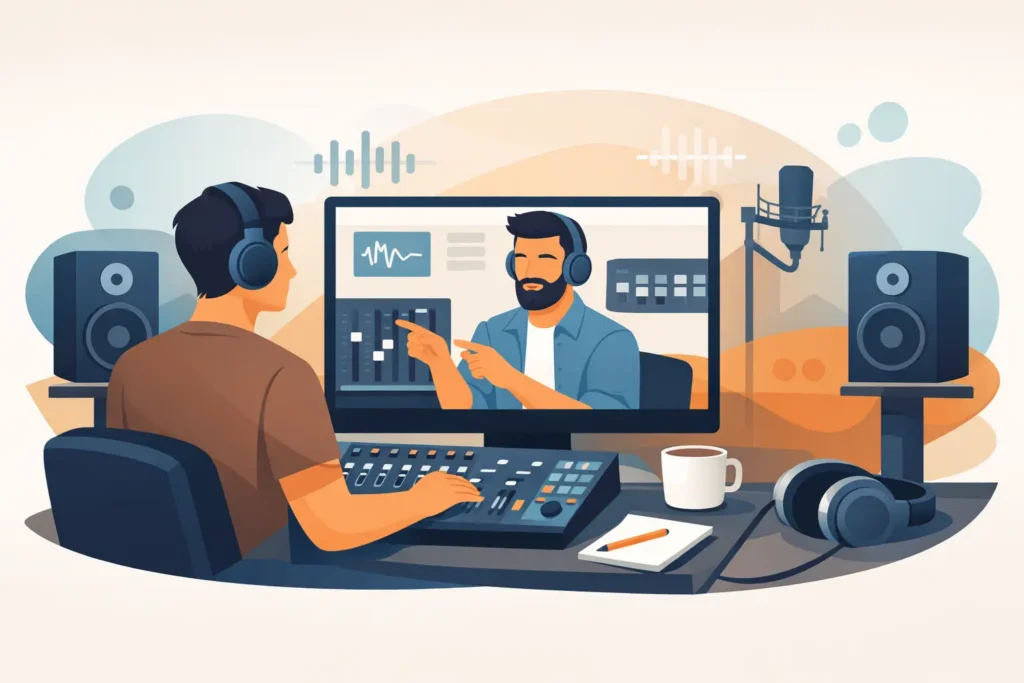
You can spend six hours tweaking an EQ, compare your mix to three reference tracks, watch another tutorial, and still end the night with the same problem – vocals too buried, drums too small, low end too blurry. That is exactly why mixing coaching for home studio producers has become so valuable. The issue usually is not effort. It is trying to solve specific mix problems with generic advice that does not match your room, your DAW, your plugins, or your habits.
A home studio mix can go wrong for a lot of reasons at once. Maybe your monitors are honest but your room is not. Maybe your gain staging is inconsistent, your automation is late, or your reverbs are stacking up in a way you do not notice until the chorus hits. Maybe the mix is actually close, but you keep second-guessing every move because nobody has shown you how to make decisions with confidence. Good coaching fixes that faster than another month of guessing.
What mixing coaching for home studio users actually solves
Most people think mixing help means someone tells you to cut 300 Hz or add more compression to the vocal. That is not coaching. That is a tip. Real coaching is a working session where an engineer helps you understand why your mix is not translating and what to change in your actual setup.
That distinction matters. A home studio producer is not working in a vacuum. You are dealing with your speakers, your headphones, your room reflections, your CPU limits, your favorite plugins, your session organization, and often a DAW template that grew messy over time. If someone cannot see or hear those factors, the advice stays theoretical.
The best coaching sessions are part technical support, part ear training, and part workflow correction. One producer needs help getting vocals to sit without sounding crushed. Another needs to stop over-compressing the mix bus. Another has solid instincts but keeps making balance decisions that only work on one pair of headphones. These are different problems, and they need different solutions.
Why tutorials stop short
There is nothing wrong with learning from videos. The problem is that videos cannot answer back. If the instructor is mixing a pop track in Logic Pro with a treated room and premium monitoring, and you are mixing rock in Studio One on budget speakers in a spare bedroom, the lesson only gets you part of the way.
This is where home studio users get stuck. You understand the concept, but your version does not sound right. You try to copy plugin settings, but the source material is different. You follow a workflow, but your session already has routing issues, phase problems, or muddy arrangements. At that point, more content is not always more progress.
Mixing coaching closes that gap because it deals with your real track, not the instructor’s demo. It lets you ask, right then, why the snare is disappearing, why the bass feels loud but weak, or why your mix falls apart in the car. That kind of direct correction saves time and usually saves confidence too.
What a good coach should help you hear
A strong mix coach does more than give you fixes. They help you build judgment. That means learning how to identify whether a problem is tonal balance, dynamics, arrangement density, stereo placement, or simple level control.
For example, many home studio mixers chase clarity with EQ when the real issue is too many parts competing in the same range. Others keep adding saturation or limiting when the mix simply lacks contrast. Sometimes a vocal does not need another plugin. It needs better automation and a cleaner pocket in the instrumental.
This is the kind of progress that sticks. Once you hear why the problem is happening, you stop reaching for random solutions. You start making faster decisions, and your mixes improve across every project instead of just one song.
The real advantage of live, one-on-one help
The fastest path is usually live feedback. Not because it is flashy, but because it removes delay. You make a move, you hear the result, and a pro tells you whether it improved the mix or pushed it off course. That loop is hard to beat.
In a one-on-one remote session, an engineer can spot things you may have normalized without realizing it. Tracks clipping before the mix bus. Effects returns that are washing out the center image. Drum overheads out of phase. Vocal chains doing too much. Buffer settings causing headaches during revisions. These are common home studio issues, and they are hard to diagnose when you are working alone.
There is also a practical benefit most people overlook. Live coaching helps you develop a repeatable workflow. That matters more than one great mix. If every session starts with confusion, plugin hunting, poor routing, and endless revisions, your results will stay inconsistent. A coach can help you simplify the process so you are not rebuilding your approach every time you open a project.
How to know if you need mixing coaching for home studio work
If your mixes sound decent in your room but fall apart everywhere else, that is a sign. If you keep finishing songs but never feel sure they are release-ready, that is another one. If every mix turns into a long battle with low end, vocal placement, harshness, or loudness, you are probably past the point where more random advice is useful.
This is not only for beginners. Intermediate and advanced users often benefit the most because they already know enough to work quickly, but they have blind spots that keep repeating. Sometimes the issue is technical. Sometimes it is decision-making. Sometimes it is simply that nobody has audited the full chain, from recording through mix bus.
A good coach should be able to meet you where you are. If you need fundamentals, they should teach fundamentals. If you need advanced mix translation strategies, automation tactics, or DAW-specific workflow help, they should be able to go there too. Anything less is just another broad lesson dressed up as coaching.
What to look for in a coaching service
First, look for real-time support. Mixing questions lose value when answers arrive a day later and the moment has passed. Second, make sure the coach can work in your DAW and understands the realities of home studio hardware, interfaces, routing, and monitoring. If they only know textbook mixing, they may miss the practical issues causing your bottleneck.
You should also look for someone who can explain choices clearly instead of hiding behind vague language. A useful coach can tell you why they are cutting a frequency, why they are leaving something alone, and when not to process further. That last part matters. Overmixing is one of the biggest problems in home studios, and not every mix needs more treatment.
This is where a service like OBEDIA fits naturally for many producers. The value is not just that you can get instruction. It is that you can get direct access to a real engineer who can work with your setup in real time and help you solve the exact problem in front of you.
Better mixes come from better decisions, not more plugins
Home studio producers are constantly sold one more plugin, one more preset pack, one more secret chain. Most of the time, the missing piece is not gear. It is clarity. Knowing what to listen for. Knowing when to stop. Knowing how to organize a session so the mix can happen without friction.
That is what coaching changes. It shortens the distance between confusion and action. It shows you how to get more from the tools you already own. It helps you build a system that produces results under real conditions, not perfect ones.
There are trade-offs, of course. Coaching is more direct than passive learning, which means you have to show up ready to work and apply feedback. It also helps most when the guidance is specific and honest, not just encouraging. But if your goal is to finish stronger mixes faster, that is exactly the point.
The producers who improve the quickest are usually not the ones consuming the most content. They are the ones getting the right feedback at the right moment, then putting it to use on actual music. If your home studio mixes keep hitting the same wall, the smartest move may be to stop searching for more general advice and start getting coached through the mix in front of you.